Salary Calculator – Calculate Your Salary After Tax
Planning your next payday or considering a new job? Our Salary Calculator NZ helps you understand how much of your salary you could actually take home after tax. Enter your earnings to estimate your pay and get a clearer picture of your income in New Zealand.
Whether you earn an annual salary or an hourly rate, you can use the calculator to understand your estimated earnings across different pay periods, including weekly, fortnightly and monthly pay. It makes comparing job offers and planning your budget easier.
See how PAYE income tax and applicable deductions may affect your earnings, so you can make more informed decisions about your income. Get a quick salary estimate and know what to expect before your next payday.

Salary Calculator NZ: What Do You Take Home?
Enter your gross salary to see your New Zealand PAYE tax, ACC earners' levy, KiwiSaver, student loan and take-home pay, and where every dollar goes.
NZ income tax rates 2026–27
Pay Breakdown
Pay Rise Comparison
Calculate Your Salary with Our Salary Calculator
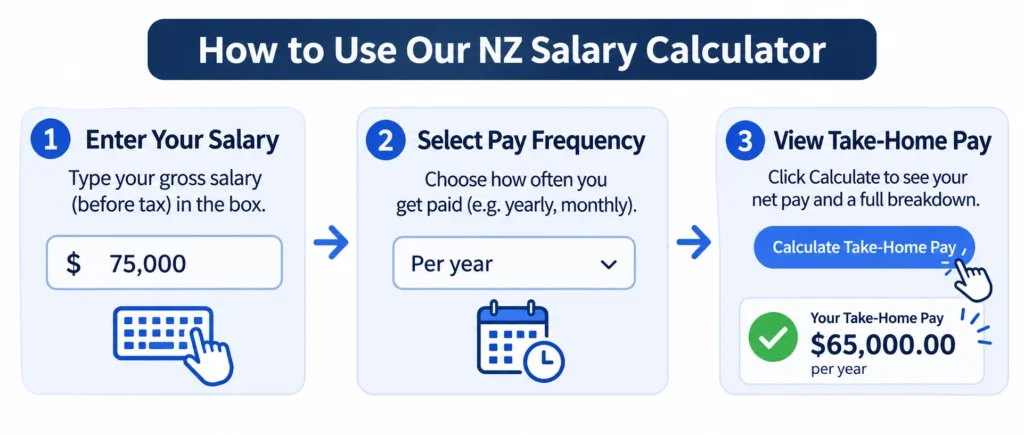
Find out how much of your earnings you could actually take home. Simply enter your salary or hourly rate, select your pay period, and get a clear estimate of your income after tax, along with a breakdown of applicable deductions.
Enter Your Annual Salary or Hourly Rate
Start by entering your gross earnings (the amount you earn before tax or deductions). You can use your annual salary or hourly rate, depending on how you are paid. Make sure to enter the correct amount so your estimated take-home pay reflects your earnings more accurately.
Select Your Pay Frequency
Select the pay period that matches your regular payday, whether you receive your salary weekly, fortnightly, monthly or annually. This helps you compare your earnings over the period you prefer and understand how much you can expect to receive after tax.
Understand Your Estimated Take-Home Pay
Once you enter your details, review your estimated salary after tax and the deductions that apply to your earnings. Your results help you see the difference between your gross pay and take-home pay, so you can better understand how much you may receive in your bank account each payday.
Convert Your Salary into Hourly, Weekly, Fortnightly and Monthly Pay
Not sure how your annual salary compares with your hourly rate or regular pay? Understanding these conversions can help you compare job offers, plan your budget and know what you earn over different periods. Explore the calculations below to see how your salary translates into the pay schedule that suits you.
Annual Salary to Hourly Rate Calculator
Want to know what you earn per hour on an annual salary? Divide your yearly income by the total hours you work in a year to estimate your hourly rate. For example, if you earn NZ60,000 annually and work 40 hours per week for 52 weeks,your hourly rate is approximately NZ 28.85 before tax.
Hourly Rate to Annual Salary Calculator
Working by the hour and want to know what you could earn in a year? Multiply your hourly rate by the number of hours you work each week, then multiply that amount by 52 to estimate your annual salary. For example, at NZ 30 per hour and 40 hours a week,your estimated yearly earnings would be NZ62,400 before tax.
Calculate Your Monthly Salary
Want to know how much of your annual income you earn each month? Simply divide your annual salary by 12 to estimate your monthly gross pay. For example, an annual salary of NZ 60,000 works out to NZ 5,000 per month before tax, helping you plan regular expenses and manage your monthly budget.
Calculate Your Fortnightly Salary
If you are paid every two weeks, divide your annual salary by 26 to estimate your fortnightly gross pay. For example, an annual salary of NZ 60,000 works out to approximately NZ2,307.69 every two weeks before tax. Knowing this amount can help you plan bills, manage regular expenses and understand what to expect on each payday.
Calculate Your Weekly Salary
If you receive an annual salary, divide your yearly earnings by 52 to estimate your weekly gross pay. For example, an annual salary of NZ 60,000 equals approximately NZ 1,153.85 per week before tax. This makes it easier to plan weekly expenses and understand how your yearly income translates into regular pay.
Salary Calculator After Tax
Your annual salary is not always the amount you receive in your bank account. In New Zealand, PAYE income tax and other applicable deductions can reduce your gross earnings before payday. Understanding the difference between gross and net salary helps you estimate your actual take-home pay and plan your finances with greater confidence.
What Is Net Salary?
Net salary is the amount of money you actually receive after tax and other applicable deductions are taken from your gross earnings. In New Zealand, this is commonly called your take-home pay. Knowing your net salary helps you understand how much money you have available for everyday expenses, savings and financial commitments.
Gross Salary vs Net Salary: What’s the Difference?
Gross salary is your total earnings before tax and other deductions, while net salary is what remains after these amounts are taken out. For example, if your annual gross salary is NZ$60,000, your actual take-home pay will be lower depending on your tax and applicable deductions. Understanding this difference helps you compare job offers and plan your budget based on the money you actually receive.
deductions
→
Example for 2026/27 before KiwiSaver and student loan repayments. Your own deductions may differ.
How Is Salary Tax Calculated ?
In New Zealand, salary tax is calculated using a progressive tax system, meaning different portions of your annual income are taxed at different rates. Your employer generally deducts PAYE (Pay As You Earn) from each payday based on your earnings and tax code. The amount withheld affects your take-home pay, so understanding how these deductions work can help you estimate your income after tax.
What Deductions Affect Your Take-Home Salary?
Your take-home salary can be lower than your gross earnings because several deductions may be taken from your pay before it reaches your bank account. In New Zealand, these can include PAYE income tax, the ACC earners’ levy, KiwiSaver contributions and student loan repayments. Understanding each deduction helps you see where your earnings go and estimate how much you will actually receive on payday.
PAYE Income Tax
PAYE (Pay As You Earn) is deducted from your salary by your employer and paid to Inland Revenue (IRD). The amount depends on your income and tax code, so using the correct details in a salary calculator NZ helps you estimate your take-home pay after tax more accurately.
ACC Earners’ Levy
The ACC earners’ levy is a compulsory deduction that helps fund injury cover in New Zealand. It is generally deducted from your salary alongside PAYE, reducing your take-home pay. Including the applicable ACC levy in your salary calculation helps you estimate your net income more accurately.
KiwiSaver Contributions
If you are enrolled in KiwiSaver, your chosen employee contribution rate determines how much is deducted from your salary for retirement savings. A higher contribution means less money in your regular pay, so consider your KiwiSaver rate when estimating your take-home salary in New Zealand.
Student Loan Repayments
If you have a New Zealand student loan, repayments may be deducted automatically from your salary when your income exceeds the repayment threshold. These deductions reduce your take-home pay, so include your student loan details when estimating your salary after tax to get a more realistic picture of your payday income.
How to Calculate Your Annual Salary from Hourly or Weekly Pay ?
Want to know how much you earn in a year if you are paid hourly or weekly? You can calculate your annual salary using a simple formula based on your pay rate and working hours. The examples below show how to convert your regular earnings into yearly income in New Zealand.
Annual Salary Calculation Formula
To calculate your annual salary, multiply your regular pay by the number of pay periods in a year. For hourly workers, multiply your hourly rate by weekly working hours and then by 52; for weekly-paid employees, multiply your weekly pay by 52 to estimate your yearly gross income.
Calculate Annual Salary from Hourly Rate
If you are paid by the hour, you can estimate your annual salary by multiplying your hourly rate by the hours you work each week and then by 52. For example, earning NZ$30 per hour for 40 hours a week gives you an estimated annual salary of NZ$62,400 before tax.
Calculate Annual Salary from Weekly Pay
If you receive a fixed weekly wage, multiply your weekly pay by 52 to estimate your annual salary before tax. For example, earning NZ$1,200 per week gives you an estimated yearly income of NZ$62,400, making it easier to compare job offers and plan your annual budget.
Salary Calculation Examples
See how different pay rates translate into annual income with these simple salary calculation examples. Whether you earn an hourly rate or a weekly wage, these examples help you estimate your yearly gross salary and compare different earning arrangements in New Zealand.
Hourly Rate vs Annual Salary: Quick Comparison
Use this table to compare common hourly rates and weekly hours.
| Hourly rate | Weekly hours | Estimated annual salary (before tax) |
|---|---|---|
| NZ$23.95 (adult minimum wage) | 40 | NZ$49,816 |
| NZ$25.00 | 40 | NZ$52,000 |
| NZ$30.00 | 40 | NZ$62,400 |
| NZ$35.00 | 40 | NZ$72,800 |
| NZ$40.00 | 40 | NZ$83,200 |
| NZ$30.00 | 30 | NZ$46,800 |
| NZ$30.00 | 20 | NZ$31,200 |
| NZ$25.00 | 20 | NZ$26,000 |
Figures are gross (before tax) and assume 52 paid weeks a year.
Gross Salary vs Take-Home Salary
Your gross salary and take-home salary are not the same. Gross salary is what you earn before tax and other deductions, while take-home pay is the amount you actually receive in your bank account. Understanding the difference helps you compare job offers and plan your budget using your real income.
What Is Gross Salary?
Gross salary is the total amount you earn before PAYE income tax and other deductions are taken out. It includes your agreed wages or salary before deductions, making it the starting point for calculating your annual income and estimating your take-home pay in New Zealand.
What Is Take-Home Salary?
Take-home salary is the amount you actually receive in your bank account after PAYE income tax and other applicable deductions are taken from your gross earnings. Also known as net salary, it helps you understand how much money you have available for everyday expenses, savings and bills.
How Much of Your Salary Do You Keep After Tax?
The amount of your salary you keep after tax depends on your annual income, tax code and applicable deductions, such as the ACC earners’ levy and KiwiSaver contributions. Use a salary calculator NZ to estimate your take-home pay and understand how much of your gross earnings you can actually spend or save.
Full-Time vs Part-Time Salary Calculation
Your salary can vary depending on how many hours you work each week. Whether you have a full-time or part-time job, understanding how your pay is calculated helps you compare earnings, estimate annual income and plan your budget. Explore the calculations below to see how working hours affect your salary in New Zealand.
How Is Full-Time Salary Calculated?
A full-time salary is generally based on a regular working schedule, commonly 40 hours per week in New Zealand. To estimate your annual earnings from an hourly rate, multiply your hourly pay by your weekly working hours and then by 52.
How Is Part-Time Salary Calculated?
Part-time salary is calculated according to the hours you work compared with a full-time schedule. Multiply your hourly rate by your weekly working hours and then by 52 to estimate your annual gross income before tax.
What Does 0.8 FTE Mean?
0.8 FTE (Full-Time Equivalent) means you work 80% of a standard full-time schedule. For example, if full-time hours are 40 per week, 0.8 FTE equals 32 hours per week, helping you understand how your working hours affect your salary.
The 32 hours can also be spread differently, such as 6.4 hours a day over 5 days.
How to Calculate Pro Rata Salary?
A pro rata salary is a proportion of the full-time salary based on the hours you work. Divide your weekly hours by the standard full-time hours, then multiply the result by the full-time annual salary to estimate your part-time earnings before tax.
Contractor vs Employee Salary
Choosing between contract work and permanent employment?
A contractor may receive a higher hourly rate. Their overall earnings can still differ because of taxes, business expenses, unpaid leave and other costs.
Understanding these differences helps you compare contractor rates with an employee salary and make a more informed decision.
What Is the Difference Between Contractor and Employee Pay?
Employees generally receive regular wages or a salary, with their employer deducting PAYE from their pay.
Independent contractors usually manage their own tax obligations, business expenses and invoicing. Their hourly or daily rate does not represent the same take-home income as an employee’s salary.
How to Compare a Contractor Rate with an Annual Salary?
To compare a contractor rate with an annual salary, multiply the hourly rate by your expected working hours and billable weeks per year.
Then account for expenses, unpaid holidays, insurance and tax obligations. This shows the real difference between contractor earnings and an employee’s gross salary.
| Feature | Employee | Contractor |
|---|---|---|
| Payment | Regular salary or wages | Hourly, daily or project rate, paid on invoice |
| PAYE / income tax | Employer deducts PAYE each payday | No PAYE. Some work has schedular (withholding) tax deducted, otherwise the contractor pays provisional tax |
| GST | Not applicable | Must register if income reaches NZ$60,000 a year, then charges GST on invoices |
| ACC levy | Earners’ levy is deducted through PAYE | Contractor pays ACC levies separately |
| KiwiSaver | Employer contributes (minimum 3.5% from 1 April 2026) | No employer contribution; can contribute voluntarily |
| Annual leave | Minimum 4 weeks paid leave | Generally unpaid unless in the agreement |
| Sick leave and public holidays | Paid sick leave and public holidays | Generally unpaid |
| Minimum wage | Applies | Does not apply |
| Business expenses | Usually employer-funded | Contractor pays (tools, insurance, vehicle) and may claim tax deductions |
| Tax responsibilities | Employer handles PAYE | Contractor handles tax returns, GST and provisional tax |
General guide only. Your actual position depends on your contract and the real nature of the work. Confirm details with Inland Revenue or Employment New Zealand.
Frequently Asked Questions About Salary Calculator
1. How Do I Calculate My Salary in New Zealand?
Enter your gross earnings and pay frequency into a salary calculator NZ to estimate your income before and after tax.
2. How Do I Calculate My Annual Salary from an Hourly Rate?
Multiply your hourly rate by weekly working hours and then by 52. For example, NZ$30 per hour for 40 hours a week equals NZ$62,400 annually before tax.
3. How Do I Convert My Annual Salary into Monthly Pay?
Divide your annual gross salary by 12 to calculate your monthly pay. For example, NZ$60,000 annually equals NZ$5,000 per month before tax.
4. What Is the Difference Between Gross Salary and Net Salary?
Gross salary is your income before deductions, while net salary is what you receive after tax and other applicable deductions.
5. Can I Calculate My Salary After Tax in New Zealand?
Yes, an NZ salary after tax calculator estimates your take-home pay after applicable PAYE and other deductions.
6. How Do I Calculate My Fortnightly Salary?
Divide your annual salary by 26 to estimate your fortnightly pay before tax.
7. Can I Calculate My Salary Based on Hourly Working Hours?
Yes, multiply your hourly rate by the hours you work to estimate your earnings using a salary calculator NZ per hour.
8. What Is a Pro Rata Salary?
A pro rata salary is a proportion of a full-time salary based on the hours worked. It is commonly used to calculate part-time earnings.
9. Is an Online Salary Calculator Accurate?
An online salary calculator provides an estimate based on your income, tax details and applicable rates. Your actual payslip may vary.
10. Is This Salary Calculator Free to Use?
Yes, our salary calculator NZ is free to use and helps you estimate your earnings across different pay periods.
Related calculators and guides
Disclaimer:
This calculator gives an estimate for the 2026/27 New Zealand tax year and is not tax advice. Your actual deductions may differ depending on your tax code, employer payroll settings and personal circumstances. Always confirm details with Inland Revenue.