Weekly Calculator
Not sure how much of your salary you actually earn each week? Our Weekly Calculator helps you work out your weekly pay from your annual, monthly or hourly salary, so you can understand your earnings in a simple way.
Enter your salary, choose your pay frequency and get an estimate of your weekly income. Whether you are paid monthly, fortnightly or by the hour, you can quickly convert your earnings into a weekly amount.
If you want to understand what you take home after deductions, you can also use the calculator to estimate your weekly pay after applicable New Zealand income tax and other selected deductions.
Weekly Pay Calculator NZ
Enter your gross pay for the week, fortnight, four weeks or month to see your New Zealand PAYE tax, ACC earners' levy, KiwiSaver, student loan and take-home pay.
Your Payslip
All Pay Periods at a Glance
The same pay shown for every pay period. Your pay period is highlighted.
How to use the Weekly Calculator NZ
Getting your weekly pay shouldn’t involve complicated calculations. Our Weekly Calculator NZ makes it easier to understand how much you earn and how much you actually take home after deductions.
- Enter your gross pay (before tax).
- Choose how often you are paid: weekly, fortnightly or monthly.
- Select your tax code and KiwiSaver rate.
- Press Calculate to see your take-home pay for each pay period and for the year.
Whether you’re paid weekly, fortnightly or monthly, this calculator helps you compare your income across different pay periods and plan your budget with a clearer picture of what you have available.
What if my hours change every week?
Casual work, shifts and overtime make weekly pay jump around, and it’s hard to plan when you never know what next week looks like. The easiest fix is to work with an average instead of a single week.
Add up your gross pay for the last 4 to 12 weeks.
Divide by the number of weeks you added up.
Type that average into the calculator.
For example, if your last four weeks were $1,000, $1,300, $1,150 and $1,350, that’s $4,800 in total. Divided by 4, your average is $1,200 a week. Use that figure to estimate your yearly pay and to set a budget you can stick to, even in a quiet week.
How to Convert Weekly Pay into an Annual Salary?
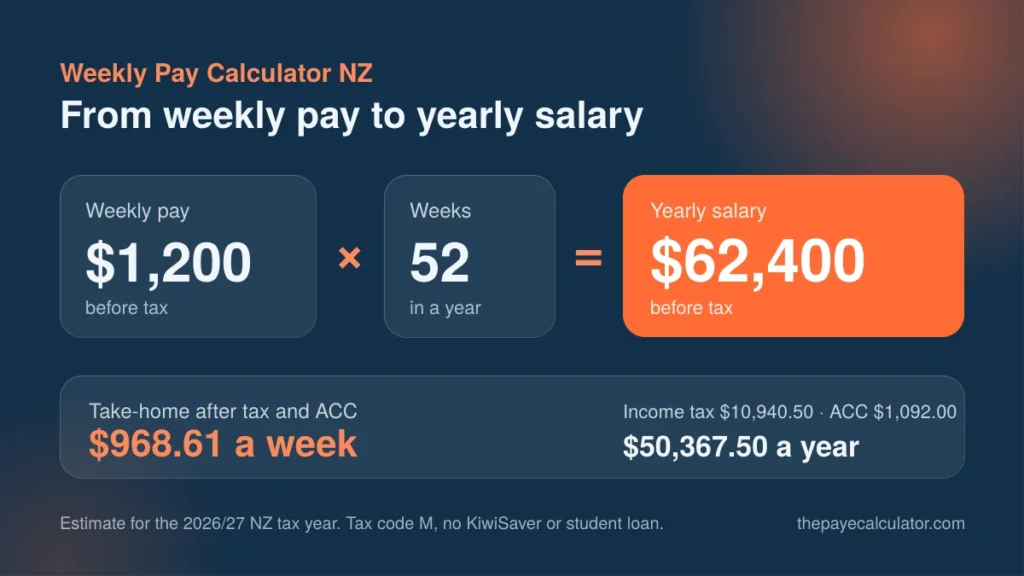
Your weekly pay gives you a clear picture of what you earn each payday, but looking at your annual salary helps you understand your income over the entire year. In New Zealand, you can estimate your yearly gross salary by multiplying your weekly pay by 52, representing the weeks in a year.
For example, if you earn NZ$1,200 per week before tax, your estimated annual salary is NZ$62,400 (NZ$1,200 × 52). This simple calculation makes it easier to compare job offers, understand your total earnings and plan your yearly budget.
Is a $65,000 salary better than $1,200 a week?
When one job advertises a weekly rate and another quotes a yearly salary, it’s hard to tell which pays more. Put them on the same footing by converting the yearly figure into a weekly one. Divide it by 52.
$65,000 ÷ 52 = $1,250 a week. So the salary offer pays $50 more every week than the $1,200 job, or $2,600 more across the year, before tax.
Before you decide, it’s worth asking two more things. Does the salary include the employer’s KiwiSaver contribution, or is it on top? And are the hours the same? A higher weekly rate for 45 hours can be worth less than a lower rate for 37.5.
Worked example: $1,200 gross per week
|
Step |
Amount |
|---|---|
|
Gross weekly pay |
$1,200.00 |
|
Gross annual pay (× 52) |
$62,400.00 |
|
Income tax |
$10,940.50 |
|
ACC earners’ levy (1.75%) |
$1,092.00 |
|
Take-home per year (no KiwiSaver) |
$50,367.50 |
|
Take-home per week |
$968.61 |
|
Take-home per fortnight |
$1,937.21 |
|
Take-home per month |
$4,197.29 |
How much is a pay rise really worth each week?
A $50 weekly raise sounds great, and it is, but you won’t keep all of it. At a yearly income of about $62,400, the next dollar you earn is taxed at 30%, and the ACC levy takes a further 1.75%. So of every extra $50, you keep roughly $34 before KiwiSaver.
That’s still $34 more in your pocket every single week, or around $1,775 over a year. Knowing the real figure helps you judge whether a raise, extra shifts or a longer commute are worth it.
Weekly, fortnightly and monthly pay
|
Pay frequency |
Pay periods per year |
Annual gross= |
|---|---|---|
|
Weekly |
52 |
weekly pay × 52 |
|
Fortnightly |
26 |
fortnightly pay × 26 |
|
Monthly |
12 |
monthly pay × 12 |
|
Every four weeks |
13 |
four-weekly pay × 13 |
How do I budget when I’m paid weekly but my bills are monthly?
Rent, power and phone bills often don’t line up neatly with your payday, and that’s where budgets quietly fall apart. Many people multiply their weekly take-home by four and call it a month. That doesn’t work, because a year has 52 weeks, not 48.
Here’s what it looks like with $968.61 a week. Four weeks gives you $3,874.44. But your real monthly average is $4,197.29, because you’re paid 52 times a year and a month is about 4.33 weeks. That’s a difference of around $322 a month.
A simple way to handle it
-
Budget on the monthly average
Don’t multiply your weekly pay by four. Use the monthly average, because a year has 52 pay weeks, not 48.
-
Match bills to your payday
Move your bills to weekly payments if your provider allows it, so they line up with when you get paid.
-
Use five-payday months wisely
Treat the extra payday as a chance to top up savings or clear a bill, not as spare cash.
What should I do if my payslip doesn’t match the calculator?
A small difference is normal. Your employer’s payroll uses IRD’s PAYE tables for each pay period, while this calculator works from a yearly figure, so the two can sit a few dollars apart. If the gap is bigger than that, go through this list:
-
Tax codeIs it the right one? A wrong code can mean too much or too little tax is taken.
-
KiwiSaver rateCheck the percentage on your payslip matches what you chose.
-
Student loanIf you have one, deductions usually apply on top of PAYE.
-
Overtime or bonusesExtra payments can push a pay period into a higher tax rate.
-
HoursMake sure the gross figure matches the hours you actually worked.
If everything above looks right and the numbers still feel off, talk to your employer’s payroll team first. For tax code or IRD questions, Inland Revenue is the right place to confirm.
Frequently asked questions
Related calculators and guides
Disclaimer
This calculator gives an estimate for the 2026/27 New Zealand tax year and is not tax advice. Your actual deductions depend on your tax code, employer payroll and personal circumstances. Always confirm details with Inland Revenue.